
Most beginners hear “download the app, log in, and trade” and assume access is the only hurdle. That’s a useful start, but it masks three separate problems: how the exchange secures accounts, how your choices change counterparty and smart-contract risk, and how the tools OKX offers shift the decision tree for an American trader. This commentary disentangles those threads so you leave with a clearer mental model of what logging into OKX actually buys you, what it doesn’t, and how to make choices that match your tolerance for custody, leverage, and regulatory friction.
Short answer for readers who want the practical step: if you’re ready to create an account and want a direct path, use the official login flow (for convenience, see okx login). But before that click, spend three minutes reading the sections below—those minutes map to risk you can avoid and yield you can realistically earn without pretending the exchange and Web3 wallet are interchangeable.
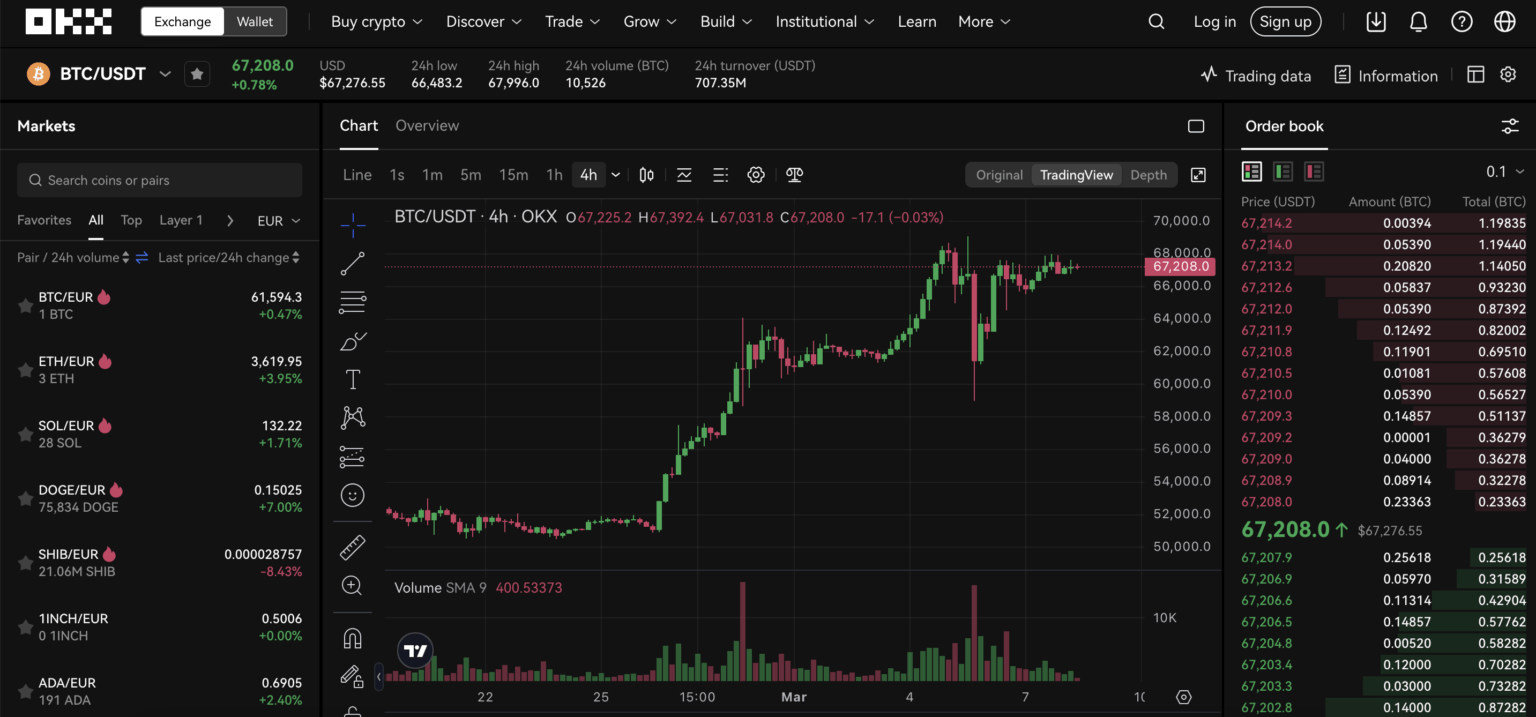
How OKX Structures Access and What That Means Practically
Mechanism first: OKX is a hybrid platform. It operates as a centralized exchange (CEX) — you deposit assets into an account it holds — and simultaneously offers a non-custodial Web3 wallet where you keep your private keys. For a US-based trader, this split matters because the risks and regulatory checkpoints are different. Depositing into the CEX requires Know Your Customer (KYC), including ID and a facial liveness check; using the Web3 wallet does not, but the wallet puts responsibility for seed-phrase security squarely on you.
Security mechanisms are robust on both sides but operate differently. The CEX side uses military-grade encryption, AI-driven login threat detection, mandatory two-factor authentication (2FA) options (SMS, Google Authenticator, or biometrics), and stores over 95% of assets in multi-signature cold storage. Those design choices reduce systemic custodial hacks but do not eliminate user-level threats like phishing or credential reuse. The Web3 wallet, by contrast, invites a different class of failure: loss of seed phrase equals permanent loss, and smart-contract interactions can be exploited if you grant open approvals to malicious DApps.
Trade-off summary: if you want convenience and a path into staking, derivatives, or fiat on-ramps, CEX custody with KYC is pragmatic. If your priority is absolute custody and censorship-resistance, self-custodial Web3 wins — but with higher operational risk and responsibility.
Trading Tools, Leverage, and Where Things Break
OKX presents a large toolkit: spot trading, margin up to 10x, futures and derivatives with up to 125x leverage on certain contracts, and an integrated DEX aggregator for cross-chain swaps. Mechanically, margin amplifies both gains and losses by borrowing against your position; perpetual swaps use funding rates to peg prices to spot. These are well-designed tools when you understand margin maintenance, liquidation thresholds, and the liquidity profile of the underlying asset.
Key limitations to keep in mind: (1) High leverage is a volatility tax — the more leverage you use, the less volatility the market must move against you to trigger liquidation. (2) Low-volume tokens suffer from wide bid-ask spreads and slippage; aggressive limit orders or routing through the DEX aggregator can partially mitigate this, but not eliminate the cost. (3) Derivatives depend on counterparty and margin mechanics that differ from spot — insurance funds and auto-deleveraging mechanisms exist, but they can activate in stressed markets, changing expected payoffs.
Decision-useful heuristic: match leverage to liquidity. For BTC and ETH, where order book depth is high, conservative leverage (2x–5x) still allows meaningful exposure while reducing ruin risk. For small-cap tokens, use spot or small margin only, and prefer limit orders to market orders to control slippage.
Yield, Staking, and the Real Choices Behind Passive Income
OKX offers flexible staking, fixed-term lock-ups, DeFi yield farming, and auto-compounding — each with a different risk-return profile. Mechanically, centralized staking pools abstract validator selection and slashing risk but introduce custodial counterparty risk: your staked tokens are effectively controlled by the platform. Self-custodial staking (using your own validator or liquid staking derivatives) gives more control but requires technical competence and exposes you to protocol-level risks.
Trade-offs: flexible staking gives liquidity but pays lower yields; locked staking pays more but reduces optionality during rallies or protocol events. DeFi yield farming can beat both but exposes you to smart contract exploits and impermanent loss. For US users, tax treatment also matters — staking rewards are taxable on receipt, and reporting obligations increase with DeFi activity.
Web3 Integration, NFTs, and Cross-Chain Workflows
OKX’s Web3 wallet and DEX aggregator bridge centralized and decentralized workflows: you can move assets between chains, trade via pooled liquidity, and buy or mint NFTs across Ethereum, Solana, and Polygon. The aggregator optimizes swap routes by pulling liquidity from major DEXs, reducing slippage and gas costs in many cases. That said, cross-chain transfers still carry bridge risk (smart contract bugs, relayer outages) and occasional delays or failed transactions that require careful troubleshooting.
For collectors and creators, the NFT marketplace simplifies onboarding by sharing a single identity across CEX and Web3 activity. But the core constraint remains: NFTs are subject to marketplace liquidity limitations and royalty enforcement depends on marketplace cooperation rather than immutable protocol rules.
For more information, visit okx login.
Account Protection in Practice — Not Just a Checklist
OKX enforces 2FA and uses AI to detect suspicious logins, but defensive posture should be layered. Practical steps: use unique, strong passwords stored in a reputable password manager; enable Google Authenticator or hardware-backed biometrics rather than SMS when possible; whitelist withdrawal addresses if you’ll keep funds on the exchange; and separate accounts if you trade frequently versus hold long term. If you use the Web3 wallet, integrate a hardware wallet like Ledger or Trezor for high-value holdings and never paste seed phrases into applications or websites.
Common misconception corrected: mandatory 2FA does not remove phishing risk. A well-crafted phishing page that captures credentials and 2FA tokens can still succeed if users reuse passwords or ignore browser warnings. Always verify domain names, use bookmarked login pages, and prefer the official mobile app for trading if you rely on biometrics.
Comparing Alternatives — Where OKX Fits Among Peers
Compare OKX to two typical alternatives: a) a purely centralized US-based exchange with strong fiat rails but limited Web3 features; b) a purely decentralized workflow using wallets and DEXs. OKX is a hybrid: it offers deep order books, fiat on-ramps, and derivatives like a CEX, while also providing a Web3 wallet, DEX aggregation, and NFT capabilities. That makes it attractive for traders who want a single interface across activities.
What OKX sacrifices relative to each alternative: against the strict CEX, it increases complexity by adding self-custodial choices; against a decentralized-only approach, it increases regulatory exposure (KYC) and custody concentration. Your selection should depend on your primary objective: active derivatives and fiat access tend to favor a CEX or hybrid; maximal decentralization favors wallet-first strategies.
What to Watch Next — Signals That Change the Playbook
Short-term signals: custody transparency via Proof of Reserves and further product integrations (mobile app upgrades) reduce some counterparty uncertainty; watch whether on-chain PoR proofs expand in frequency or granularity. Regulatory signals matter most for US traders: changes to KYC or stablecoin rules could affect deposit/withdrawal flows. For traders, watch liquidity migration across derivatives venues during macro events: funding rates and basis spreads can create short-term arbitrage or risk spikes.
Conditional scenario to monitor: if macro volatility increases and retail flow returns to crypto, expect wider spreads on low-volume tokens, increased use of leverage by novice traders, and higher strain on order books — that combination favors conservative sizing and pre-placing limit orders.
FAQ
Do I need to complete KYC to use OKX?
Yes for deposits and trading on the centralized exchange side — OKX requires identity verification (government ID and a liveness check) to comply with AML regulations. You can use the non-custodial Web3 wallet without KYC, but that wallet does not provide fiat on-ramps or centralized staking services.
Is my money safe on OKX?
“Safe” is relative. OKX stores over 95% of assets in air-gapped multi-signature cold storage and offers Proof of Reserves transparency, which materially reduces systemic custodial risk. However, user-level risks — phishing, credential reuse, social engineering, or smart-contract exploits when interacting with DeFi — remain. The practical defense is layered security: unique passwords, hardware wallets for large holdings, and careful approval management for DApps.
Should I use OKX’s Web3 wallet or keep everything on the exchange?
It depends on your priorities. Use the Web3 wallet if you value self-custody and interaction with decentralized apps; use the exchange custody if you prioritize convenience, fiat rails, and access to derivatives and staking without managing private keys. A common compromise is a split strategy: keep smaller trading balances on the exchange and larger, long-term holdings in a hardware-backed Web3 wallet.
Final practical rule: design your entry and login routine to match the worst-case scenario you can tolerate. If a login or seed loss would be ruinous, choose hardware-based keys and cold storage; if liquidity and speed matter more, accept the trade-offs of exchange custody but enforce strict operational security. In either case, know which layer you’re operating on — CEX custody, self-custodial Web3, or a mix — and let that guide position sizing, leverage, and which features (staking, NFTs, derivatives) you use.
Leave A Comment