
The History of Les Arcs and Paradiski
 daan.frijlink
From Alpine Pastures to a World-Class Ski Area
Today, Les Arcs and Paradiski form one of the largest connected ski areas in the French Alps. With 425 kilometres of pistes, the domain brings together Les Arcs, Peisey-Vallandry and La Plagne.
However, this vast ski area did not begin as one project. Les Arcs and La Plagne developed separately on opposite sides of the Ponthurin Valley. Only in 2003 were the two areas connected by the Vanoise Express, creating Paradiski as we know it today.
This timeline explores how local mountain residents, architects, entrepreneurs and engineers transformed the slopes above Bourg-Saint-Maurice into a pioneering Alpine destination.
1961 – Two ski areas begin to take shape
At the beginning of the 1960s, the mountains above Bourg-Saint-Maurice consisted mainly of Alpine pastures, forests and small farming communities. Winter tourism was still in its infancy.
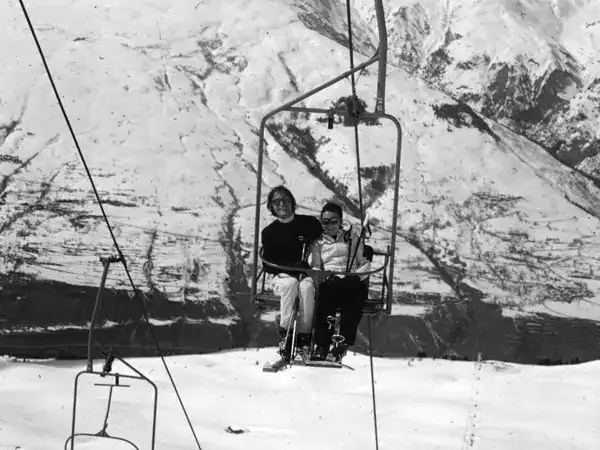
In 1961, two sections of chairlift were constructed on the north-facing slopes above Bourg-Saint-Maurice. They allowed visitors to travel directly from the valley towards Courbaton at approximately 1,750 metres.
The following year, the Biolley, Deux Têtes and Signal ski lifts opened in the Pierre Blanche area. These early facilities laid the foundations for the future Les Arcs ski area.
On the other side of the valley, La Plagne was developing at almost exactly the same time. Four municipalities joined forces to create employment as traditional agriculture and mining declined. Plagne Centre officially opened on 22 December 1961 with two drag lifts and four ski runs.
The history of Paradiski therefore began with two independent mountain projects that would only be connected several decades later.
1964–1968 – The vision behind Les Arcs and the opening of Arc 1600
A decisive moment came in 1964 when the municipalities of Bourg-Saint-Maurice and Hauteville-Gondon merged. Bourg-Saint-Maurice could provide financial support, while Hauteville-Gondon owned much of the land required for the new resort.
Three people played particularly important roles in the creation of Les Arcs:
- Robert Blanc, a local mountain guide and skier;
- Roger Godino, an entrepreneur and the project’s principal developer;
- Charlotte Perriand, an internationally recognised architect and designer.
Their ambition went far beyond building apartments and ski lifts. Les Arcs was to become a complete mountain destination in which accommodation, recreation, architecture and the landscape worked together.
Arc 1600 welcomed its first visitors at Christmas in 1968. Its access road, hotels, apartments and ski lifts marked the official birth of Les Arcs.
Led by Charlotte Perriand, a collective of architects designed buildings that followed the natural contours of the mountainside. Apartments were positioned to maximise sunlight and views, while cars were separated from pedestrians and skiers wherever possible.
Arc 1600 became more than a ski village. It was an important testing ground for modern mountain architecture.
1974 – The opening of Arc 1800
Arc 1800 welcomed its first visitors in 1974. The Hôtel du Golf and the Bellecôte and Miravidi residences were among its first major buildings.
The architects continued to follow the design principles established at Arc 1600. Instead of placing isolated towers on the mountainside, they created long buildings that followed the natural slope. Apartments were designed around daylight, privacy and uninterrupted mountain views.
A cable car between Bourg-Saint-Maurice and Arc 1600 also opened in 1974, making the growing resort easier to reach from the valley.
Arc 1800 eventually became the largest and liveliest village in Les Arcs, with several neighbourhoods, shops, restaurants and direct access to the ski area.
1979–1982 – Arc 2000 and the development of high-altitude skiing
The opening of Arc 2000 in 1979 moved the development of Les Arcs further up the mountain.
Architect Bernard Taillefer designed the resort around the Butte du Varet. Its compact form was conceived as a kind of mountain fortress, facing the sun while providing shelter from the challenging high-altitude weather.
The buildings’ powerful shapes and sloping roofs were partly inspired by ski jumps, giving Arc 2000 its distinctive appearance.
In 1982, the Aiguille Rouge cable car opened. Without an intermediate pylon, it carried skiers to the highest point of the Les Arcs ski area at 3,226 metres.
The project provided access to high-altitude terrain and one of the area’s most remarkable descents: from the summit of the Aiguille Rouge down towards Villaroger, covering more than 2,000 vertical metres.
1989 – The funicular connects the railway station to the slopes
In 1989, travelling to Les Arcs became considerably easier when the electric funicular opened between Bourg-Saint-Maurice and Arc 1600.
Directly connected to the railway station, the funicular made it possible for travellers arriving by train to reach the mountain in approximately seven minutes.
For its time, this was an exceptionally convenient and forward-thinking transport connection. Visitors could travel from major European cities to the foot of the mountain by rail and continue directly to the ski resort without requiring a car.
The funicular remains an important part of the identity of Les Arcs, connecting the historic valley town with the modern mountain villages above it.
2003 – Arc 1950 introduces a different kind of Alpine village
Arc 1950 opened in 2003 and introduced a noticeably different architectural style to Les Arcs.
Developed by the North American company Intrawest, it was designed as a high-quality, pedestrian village that could remain active throughout the year. Its architecture combines wood, stone and slate with influences from both traditional Alpine settlements and North American ski resorts.
The pistes pass directly through the village, giving most accommodation immediate access to the ski area.
Although much younger than Arc 1600, Arc 1800 and Arc 2000, Arc 1950 has become one of the most recognisable villages in Les Arcs.
2003 – The Vanoise Express creates Paradiski
The most important moment in the history of Paradiski also took place in 2003.
The opening of the Vanoise Express connected Les Arcs and Peisey-Vallandry with La Plagne. The double-decker cable car crosses the deep Ponthurin Valley without any intermediate pylons, completing the journey in approximately four minutes.
This remarkable engineering project ended the physical separation between the two large ski areas.
The name Paradiski was introduced for the combined domain of:
- Les Arcs;
- Peisey-Vallandry;
- La Plagne.
Together, they created a ski area with 425 kilometres of pistes. The Vanoise Express is therefore more than a lift: it is the physical and symbolic link between two mountain destinations that had developed independently since the early 1960s.
2006 to today – Architecture, heritage and responsibility
In 2006, the architecture of Les Arcs received the French Patrimoine du XXe siècle designation. Renamed Architecture contemporaine remarquable in 2016, the label recognises important examples of twentieth-century architecture.
The urban design and architecture of Arc 1600 and Arc 1800 were included, together with the Aiguille Rouge cable-car stations at Arc 2000.
In 2020, Les Arcs–Bourg-Saint-Maurice became the first destination in Savoie to receive the Flocon Vert sustainability label.
In 2024, the operator of the Les Arcs and Peisey-Vallandry mountain area became the first European mountain-domain operator to achieve B Corp certification.
These developments echo the original vision behind Les Arcs: creating a destination that does not simply occupy the mountain but becomes a carefully considered part of it.
A ski area where history remains visible
The history of Les Arcs and Paradiski can still be seen throughout the resort.
In Arc 1600 and Arc 1800, the modernist buildings follow the natural mountain slopes. Arc 2000 tells the story of high-altitude skiing and technical innovation, while Arc 1950 represents a younger interpretation of the pedestrian Alpine village.
The funicular reflects the ambition to connect the railway directly with the slopes. High above the Ponthurin Valley, the Vanoise Express shows how two independently developed ski areas eventually became one destination.
When you ski through Paradiski, you are therefore exploring much more than hundreds of kilometres of pistes. You are travelling through more than sixty years of architecture, engineering, local history and Alpine pioneering spirit.